Showing posts with label technology news. Show all posts

Get rid of the pesky cord that normally comes with headphones and go wireless by using Sony’s lightweight Bluetooth

Toshiba Japan announced a new portable DVD player today [JP], the SD-P93DTW, which is equipped with a One-Seg digital TV tuner. The device is Japan-only at this point. But Toshiba sells the SDP93S in the US, which is essentially the same player minus the TV tuner (the tuner is useless outside Japan and Brazil anyway). And Americans have to pay a lot less for their player. Japanese buyers will be set back a whopping $520, while the SDP93S costs just $180 at Amazon. The Japanese version is also equipped with an analogue TV tuner and supports SD/SDHC/microSD/micro SDHC cards but apart from these features (the American version supports SD cards only), it seems to be the same model: a swiveling 9-inch TFT LCD screen with 800×480 resolution, DivX support, JPEG viewer, virtual surround sound and built-in speakers. The SD-P93DTW will hit Japanese stores at the end of April.

The On Time Headset System is a bracelet that comes with a pop-out wireless headset. I suppose that is a better place to put your Bluetooth headset than your pocket.
The bracelet has a secondary display, so if your headset rings, you can just look down and see who is calling. I would imagine that the bracelet display can show the time, making it a very fancy wristwatch.
By the way, did I mention that the displays are both touchscreens? Well, they are, and they would hopefully not require tiny fingertips in order to use.
My source referred to the OnTime Headset System as the “future of bling”, and I can’t help but feel that it is about time that tech and bling combined to create something like this. Well, as I mentioned before, this is only a concept, but I already want it on my wrist.

When camping with the whole family, it can present some slight lighting issues. There are of course always ways around that, but it usually means packing four different kinds of lights and plenty of flashlights as well as batteries. Well Coleman, being one of the better brand names for camping, has come up with a different solution. It offers one giant lantern that will give light in all directions for when you’re all sitting together, but an extra perk for when you go off in different directions.
The side panels, of which there are four, all snap off. They can work individually or all together once put back on the lantern. Each individual panel has a recharageable NiMH battery, those charge off of the eight D-cell batteries that are located within the base of the lantern. Those batteries can run the lantern all together for 72 hours, a full charge of the panel will give an hour of light per panel. Due to the frosted lens and wide-angle LED lights, it will give off light over a large area. You can purchase it on the Sears website for $69.99.
I remember first seeing the Zivio Boom Bluetooth wireless headset at the 2008 Macworld Expo and thinking that it looked pretty sexy, but I wasn’t sure about the practicality of the telescoping boom microphone. It’s now one year later and they’ve sent me one to review. Let’s take a closer look. Bluetooth Version 2.1 + EDR and Multipoint Zivio Bluetooth headset My first impression of the Zivio was that it looked very Apple-esqe with its Black and chrome design. I think it has a cool tech fashion style with crisp edges and modern geometric touches in the buttons and LEDs. The outside surface has a slightly rubberized texture that feels soft to the touch. There are three buttons on the outside. The one closest to the back edge is the call answer / end button. This button (called the Joby button) has a circular pattern of LEDs that shows the status of the battery and pairing mode. It will also blink every 5 seconds to indicate that it is powered on. The + and - buttons allow you to adjust the volume. Pressing both volume buttons at the same time will toggle mute on and off. All three buttons have good tactile feedback. The earphone is located on the other side. It can swivel on its base to allow for a more customized fit. The power button and charging connector are located on the back end of the headset. The headset charges through a special USB cable that can be plugged into your computer, or into the included AC adapter. The Joby button will glow Red while the headset is charging. When charging is completed, the Joby button will glow Green. The main unique feature of the Zivio is the telescoping boom microphone. The boom is relatively easy to extend and collapse. I do have some fear that the boom could break after repeated use. It is made from really thin metal tubes. Although you can use this headset without extending the boom, the sound quality (for people on the other end of your conversations) will be better when you take advantage of this feature. Zivio offers several ways to wear this headset. They include three gel style ear pieces that will allow you to quickly insert and remote the headset from your ear. These ear pieces are soft and pretty comfortable. If you prefer using an ear hook, Zivio includes a magnetic ear hook and a snap on adapter that is used with what they call mushroom style ear pieces. The adapter snaps on the ear piece… Then a mushroom ear piece installs over the adapter. Lastly, the magnet ear hook is placed on the metal inside surface of the headset. Since the ear hook is magnetic, you can slide it around where ever works best for you. Here you see me wearing the Zivio with and without the ear hook. I actually prefer not to use the hook with this headset. For me, it takes too long to put on this headset when I’m using the hook. I’ve also pulled the magnetic hook off the headset when I remove it from my ear. Although it’s a cool idea, I’m wondering how many people would really use it on a regular basis. I have had no problems using this headset with a Nokia N85. It paired easily and the audio quality on my side of the calls was outstanding. When calls come in, the ring tone set on the phone plays through the Zivio headset. It also worked well for voice dialing. Accessing the buttons while wearing the headset is pretty easy, but I do wish that they weren’t quite so flat, so that you could feel them through a thin glove. It is Winter right now, so I’m always wearing gloves while driving. Ok, time for the sound tests! Below are several audio clips of the Zivio Boom headset in action. This will give you an idea of what it sounds like to receive a call from someone using this headset. I used the free voicemail / fax service from K7.net for these tests. I signed up for a free account, got a phonenumber and called it using a Nokia N85 while using the Zivio Boom headset. The resulting voicemails are then emailed to you. Pretty nifty! At test time, the phone had full signal strength. Click to listen. zivio-boom-outside (108k .WAV file) zivio-boom-inside (96k .WAV file) zivio-boom-car (68k .WAV file) It’s pretty apparent though these sound bites that the headset sounds much better on the caller’s side of the conversation when the boom is extended. When it is not extended, the audio sound muffled and muddy. Other than wind noise, the headset does well with canceling background noises while driving (road noise, engine noise and radio). I like the Zivio Boom Bluetooth headset because it’s easy to use, easy to charge, looks pretty nice, is comfortable to wear and has good sound quality on both sides of a conversation. That said, I haven’t made up my mind yet if the extendable boom is a great feature, or just a hassle. I’m all about gadgets being fast and easy. So if I have to pick up the headset, extend the boom and then put it on, that’s one extra step that I would not have to do with a regular headset. Am I being too picky? Yeah probably… What do you think? Would you use a Bluetooth headset with an extendable boom?Hardware Specifications
10 m (33 ft) range between phone and headset
Talk time: 10 hours
Standby time: 200 hours
Built-in rechargeable battery
Charging via power adapter or any other standard USB compliant charging device
Power adapter simultaneously charges two USB devices
Size: 53.5 x 15 x 7 mm
Weight: 13 gPackage Contents
Dual-USB wall charger
2 × USB charging cables
Quick-start pocket guide
Illustrated Manual
2 × magnetic ear loops
3 × scoop style earpieces
6 × mushroom style earpieces
2 × mushroom connectors


How would you like a 22″ widescreen wireless digital photo frame that can display up to 150,000 images on its 1680 x 1050 LCD screen and hang on your wall? You can even choose from different frame styles made of wood, metal, and leather. Sounds pretty sweet right? But would you pay $999 for it? The folks at Photovu sure hope so.

This Bluetooth bracelet from Brando won’t let you miss a call when your phone is buried at the bottom of your purse. It vibrates when a call comes in and will let you answer or reject the call. It also has a Link Loss Alert Function that will cause the bracelet to vibrate when your mobile phon,e is more than 5 Meters apart from you.

If you like 8.9-inch screens, you might want to get one now. Asus has said that it'll be phasing out that size in 2009, since 10-inch models are dominating the market.
According to Digitimes, Benson Lin, president of Asustek Computer's Asia-Pacific division said that 10-inch models account for 95% of the company's sales. 7-inch models make up the other 5%.
To be honest, I'm surprised 8.9-inches is not a popular option. Maybe I'm just weird, but I always though that screen size hit the sweet spot between fitting into a purse and still having a somewhat usable keyboard.
Microsoft Zune 120GB
Posted in 120gb, gadgetguru, microsoftzune, mp3 player, technology, technology news, zune

Microsoft’s fabled Zune line has done a lot of growing up over the years. From the first-gen 30GB player that we scorned back in 2006 to the 8GB model we warmed up to 2007, Microsoft has continually been fine tuning its line of media players to deal with the crush of criticism they’ve met on the open market. That refinement reaches its pinnacle with the 80GB and 120GB players, which are both the largest and most capable Microsoft has ever produced. But are they ready to run alongside Apple’s class-leading iPod yet?


While much of what I need is on the Web in one form or another, there are times I need to access information when there is no network available. This has been, until recently, one of the few real issues I have had with the iPhone: notes taken on my computer can’t be shared easily with my iPhone and vice-versa. Recently, I’ve been using SyncBook, an iPhone app that syncs with my Mac via text files over a local network connection.
There have recently been several different apps released that come at this issue from various angles. I have tried a few, and have come to rely on SyncBook for my needs, for reasons explained below. (A word for all the Windows and Linux folks who will complain that I don’t mention their platform - this is not my decision. The developer is not interested in the Windows market, and has no plans for creating a client there. While this is a negative for many, it holds no barrier to entry to me, so will only slightly come to bear on my final grade. Your mileage, as they say, may vary.)
SyncBook is delivered as a 1 MB app downloaded to your Mac. The iPhone app is purchased from the iTunes Store’s AppStore area at http://phobos.apple.com/WebObjects/MZStore.woa/wa/viewSoftware?id=290800829&mt=8.
I used Palm devices for most of the last decade. While I was a Newton user first (and still would be if the right device/software existed), the Palm III won me over by being in my shirt pocket whenever I needed it. Writing notes and having them sync with my Mac was quick and clean, and gave me all the data I could want in the palm of my hand. I moved up to Documents to Go during the beta test of version 1, and stayed there until DataViz dropped the ball by not providing compatibility with the MissingSync when this became the only way to sync a Mac. I moved to Mark/Space’s excellent Notebook included with that product instead. I was a happy Palm user, having had the same Tungsten|C for over three years when, about a month before iPhone Launch Day in July of 2007, several folks in my office started discussing the looming Launch with me. After a few more such conversations, I decided to get an iPhone and converge my phone and handheld.
(apology/aside for those who have yet to drink the Apple/iPhone Kool-aide)
I have never, from the first time I held that iPhone in my hands, regretted it. I live in a 3G area, my company is very Mac-oriented and many folks use iPhones. Plus, as a member of an area Mac User group, I have a lot of other friends who are also in that camp. In the last year, however, I’ve noticed that everyone everywhere that isn’t a button-down business person or lawyer seems to be toting an iPhone: mothers, pastors, chemists, architects - everyone. I see them at church, in stores, in restaurants, and on the street. Students, musicians, baristas - it’s strange to me that these things are so prominent in my area. (I live in central North Carolina, in an area known as the Research Triangle, where we have loads of high-tech companies, in addition to three large research universities: Duke University, University of NC at Chapel Hill, and NC State University. This may account for the large geek cred of the area.) For these reasons, I assume most of these people are not “Apple fanboys” but True Believers®. So, that’s my bias, but you can see where it comes from.
(end aside)
Here’s how this pair of apps works: Download the Mac version and install it. This will create a folder for saving text files in your Documents folder. Purchase the iPhone app ($3.99) and sync. In order to sync these two, you’ll need to either be on the same wireless network, or create a wireless network on your Mac for the iPhone to connect to. (How to do this is beyond the scope of this review, but it’s trivial. If you’re reading this, you’re enough of a nerd to know how to do this or to have friends who do.)

Run the app on your Mac, and in the iPhone app, click the small gear on the bottom left. This is the “Settings” icon. In Settings, the first item is Syncing. Click to search for your Mac. Once you see it, click to select it and go back to the main window. Now, whenever you want to sync, click the circular arrow on the bottom left of the screen. New notes you create on the iPhone will show up in the list on your Mac, and new text files you place in the folder the Mac app created will show up on your iPhone. (As with any syncing program, changing both versions before syncing will cause data confusion. SyncBook realizes this and does warn you, but how you get out of it is up to you, because you know which changes are more important. It’s easy enough to select all and copy on the Mac, sync, then paste in the copy and compare, but it’s so fast to sync, you shouldn’t let yourself get into this situation.)
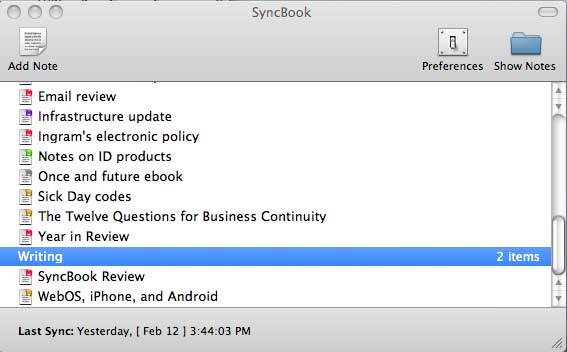
While you don’t have to, the latest version of SyncBook Mac has a button to “Add Note” that creates a note in the Notes folder, already added to the list and ready to update. I’ve been using this to create a notes with no problem.
Looking at the Mac window, you can see small color labels on some of the icons. There are unlimited categories you can add to and name as you feel, and a select few colors (helpfully named “Red”, “Orange”, “Green” and so forth) that you can optionally assign to your documents. This can only be done on the iPhone app, but shows up on the Mac at the next sync.

For the money, it’s one of the cheapest and best notes syncing apps I’ve seen. There are freebies that aren’t as powerful or require an odd format on the Mac, or require syncing through a web service, rather than directly. Evernote, the most notable challenger (and one I had been using for a while before finding SyncBook) is one such alternate. I’ll post another review of it later, but, briefly, it has a Mac client (and one for Windows), an iPhone app, and a web app, where you create a login. All data is always synced to the web first, then sent out to other clients. This works wonderfully, until you want to sync something really secure that you don’t want anyone, anywhere, to accidentally have access to - medical records, business info, financial records, whatever. With SyncBook, I can be riding on a train with no network access, fire up my Mac’s ad hoc access point, find that network on my iPhone, and sync everything immediately, securely, and with no worry about network connection speed. (I had only thought this was an issue, thinking no one would really want to look at things posted to a note account, when I saw a tweet from @EverNote commenting on a picture of a whiteboard written in Chinese. They actually sent a link to everyone on their list linking to a user’s data, and admitted that they had no idea what it said. It could have been his phone number, or plans for a new internet device, or the timetable for their bid to world domination. In any case, it was not Evernote’s right to post it. But that’s the choice you have to make when using a web service. SyncBook will never expose your data to anything beyond your local wireless LAN. If you have something you want to keep private, private it shall remain.
There are a few bumps on this road to happiness. For one, the Mac app has almost no control, other than creating, removing and showing notes. You can’t create or edit categories, sort, change labels, or anything else on the Mac. On the iPhone, you can move categories into any order you choose, add and edit categories and colors, and change font shape/size/color globally. There is a search feature on the iPhone app, but other than telling you a certain word or phrase appears in a note, it doesn’t help. (Granted, with no selection feature for text available in the iPhoneOS, this can be partially forgiven. But they could offer to find and move the cursor to the beginning of the target phrase.) Syncing via wireless is great if you have a MacBook of some flavor, but if your machine is the base-level MacPro (the only Macs that don’t ship with a built-in wireless card), you’ll have to figure out another option. One editing snag that continues to irritate me on the iPhone: when I’m editing, or even if I’m scrolling and happen to hold my finger still for too long, it switches to Edit mode, and I lose the scroll-by-flicking that is at the heart of the iPhone. I’d rather be in browse mode until I decide to edit, hit the button and go. Then I’d like to turn off the editing and go back to scrolling, without having to close the document and open it back up.
For me personally, this app combo is a solid 4 out of 5 stars. I don’t create huge notes that need internal searching, and I don’t need Windows. Sorting on the Mac and a slightly more robust viewing/sorting/categorizing feature would add a lot, as would options such as an “edit” button, but it’s so functional for me currently (in my minimalist way) that this cluster of missing features is only one star.
For many others, however, I’d have to rate it 3 or 3.5 out of 5 stars, since Windows compatibility is important, and some may be after more features. While you can’t have the same pricing and distribution structure on Mac or Windows apps that you do with iPhone apps, having an advanced “syncs with Windows” version that only added that capability and cost more but provided a “free” Windows app download would be a great feature for those callous Philistines who insist on staying with the Devil’s OS. (I’m kidding, just kidding. Stop writing hate mail!) Or charge for the Windows version, since he’s probably going to have to hire that out.

EA has announced Dead Space Extraction, a prequel to its sci-fi/horror game Dead Space...and it's being built exclusively for the Wii.
Electronic Arts has announced it is developing a prequel to its scifi/horror game Dead Space called Dead Space Extraction—and where the original Dead Space is available for the Xbox 360, PlayStation 3, and PC, Dead Space Extraction is being developed for the Nintendo Wii.
"We could not be more excited to extend Dead Space into an experience exclusive to the Wii," said EA Redwood Shores VP and general manager Glen Schofield, in a statement. "Nintendo has a wonderful history in the horror genre and we are thrilled to build on that tradition."
Promising all the blood, gore, and "intensity" Dead Space fans are used to, the prequel will tell the story of a group of space colonists who try to escape from a terrible infection spreading through a mining colony. The game will introduce new characters, weapons, enemies, and puzzles for players to solve, as well as enable cooperative multiplayer action. EA also promises Dead Space Extraction will leverage the Wii's unique motion-sensitive controller with frenzied first-person action.
The announcement falls in line with EA's new emphasis on developing games for the Nintendo Wiim, citing lower development costs to bring games to the platform—according to EA's John Riccitiello, developing standard-definition games for the Wii can cost as little as a third to a fourth of the cost of developing a title for high-definition consoles. EA's moves will also likely diversity the range of titles for the Wii, broadening the platform to include titles like Dead Space Extraction aimed at mature, hardcore gamers, rather than casual and non-traditional gamers, or children.
LOS ANGELES — Colbie Caillat's 2007 hit Bubbly is so popular online that about 800,000 people have watched YouTube videos of musicians teaching how to play the song on guitar.
Only one problem: Most got it wrong.
"They do a nice job," says the singer/songwriter, but "most don't realize it's in open D tuning and has totally different chords."
Now Caillat gets to show how it's really done. She is one of nine artists offering video music lessons at $4.99 a pop via Apple's GarageBand, the music-editing software bundled into its iLife suite of programs. Among others, John Fogerty teaches Proud Mary and Norah Jones shows you how to perform Thinking About You.
Many sites offer video music lessons now. A year ago, iVideosongs was launched with artist tutorials from Graham Nash, John Oates and Rolling Stones keyboardist Chuck Leavell. And there are thousands of free instructional videos on YouTube produced by young guitarists and teachers. Some even feature well-known performers such as Paul McCartney, Police bandmate Andy Summers and Queen guitarist Brian May. Longtime guitar-maker Gibson even devotes a page of its website to the YouTube lessons.
FIND MORE STORIES IN: Apple | YouTube | DVDs | iTunes | Amazon | Queen | Rolling Stones | Paul McCartney | Brian | Gibson | Hell | Police | Macs | Norah Jones | iMac | Sarah McLachlan | iLife | John Fogerty | John Oates | Roxanne | Los Angeles-area | Jason Mraz | Proud Mary | Andy Summers | Graham Nash | GarageBand | Ben Folds | Phil Schiller | Atlanta-area | Chuck Leavell | Competing | Guns N Roses | Stratocaster | I'm Yours | Bubbly | Sweet Child | National Association of Music Merchants | Tim Huffman
Apple's high profile — and heavy promotion of the video lessons within its 250 retail stores — brings the idea of learning music online to higher prominence. "It's a fantastic idea, and I hope they do more," says British guitarist Justin Sandercoe, who offers free video lessons at Justinguitar.com. "The idea you can have the guitar lesson with the actual artist who wrote the song is terrific. Now, a great artist may not be a great teacher — they won't be familiar with the act of teaching — but the fact is, it's Sting teaching you Roxanne."
A ministudio
GarageBand is a minirecording studio tool that often gets overlooked by Apple computer owners. As part of an overhaul for the iLife '09 program suite (free with new Macs, or $79), Apple added an instructional component to capitalize on renewed interest in playing music spawned by popular "rock band" video games.
"There's this huge problem that hasn't been attacked yet," says Phil Schiller, Apple senior vice president. "Finding a new way to teach music, from your personal computer."
He says the YouTube instructional clips — his kids watch them — "don't attempt to solve the whole problem: how to properly learn to play."
Apple has a guy named Tim (it won't reveal his last name) offering free lessons on playing guitar and piano. For $4.99, artists such as Sarah McLachlan and Ben Folds show you where to put your hands on the guitar or piano keyboard and what key they like to play the song in. They also tell you about how it came to be written.
But if you just want to find out what the chords are to AC/DC's Highway to Hell, it's all there on YouTube for free.
"This is how kids learn music now," says Stutz Wimmer, an Atlanta-area high school music teacher. In a bygone era, teens might listen to a song over and over again to figure it out. Now, "Somebody shows them the chords online."
The YouTube instructors range from professional guitarists such as Sandercoe to young teens in their bedrooms with a Stratocaster.
Edison Mellor-Goldman, 17, a Los Angeles-area high school student, likes to go home from school and make video tutorials using his iMac computer's built-in webcam. "When you teach someone one-on-one, that's great," he says. "But when you put it on YouTube and hear from 100,000 people around the world that 'you helped me' and get such a massive amount of feedback, that's really something."
He's made 33 videos. His most popular — how to play Jason Mraz's I'm Yours— has been viewed 200,000 times on YouTube.
Sandercoe began offering video lessons in 2007 as a way to attract new students. His lesson on how to play Guns 'N Roses' Sweet Child o' Mine has picked up more than 2 million views. His site attracts 600,000 viewers a month. "People can share their common love of something online. It's a fantastic resource," he says. He offers instructional DVDs for sale and asks for contributions. He says he averages about $100 a week.
Most of the lessons found on YouTube are by young teens. Many are imprecise, says Tim Huffman, CEO of Atlanta-based iVideosongs. "You get what you pay for. We offer multiple camera angles, high-definition video and accuracy."
Accessing lessons
Competing with Apple isn't easy — especially when he charges twice as much for artist lessons: $9.95 — but he says he has a few advantages. You can make purchases at the iVideosongs site or via Amazon downloads. The company also offers instructional podcasts (how to play slide guitar, the piano, etc.) at iTunes.
Apple does not offer stand-alone purchases of its copy-protected video lessons at iTunes. The only way to see Sting demonstrate Roxanne is by using a newer Mac with GarageBand.
Joe Lamond, president of the National Association of Music Merchants, a trade group for music stores (where most guitar lessons are held), says the growth of online video lessons has paid off with more-attentive students. Guitar sales — even in a recession — were up 3% in 2008, he says. He credits the Internet and video games.
We have reported on the Unibind’s Photobook Creator before, and I seem to recall saying in that review that I would probably report on Unibind again. Sure enough, I have just heard of a brand-new development that Unibind is working on. Unibind’s Photos N Sounds is “the first photo book that allows anyone to record a personalized voice message”. The recording apparatus is on the cover, and it works by hitting a record button and saying the message or music. If the user is satisfied with the message, then he or she rips off a tab to make the audio file permanent. This is perfect for scrapbookers who want to have a personalized message attached to their scrapbooking album. This can also work for businesses who want to put audio to their marketing album/brochures. In addition to the personalized message, Photos N Sounds can play popular theme songs like Christmas carols or the “Happy Birthday” song. I have a little suggestion for Unibind: make it so the user can download an MP3 via USB. I’m sure that Unibind has already thought of that, and I’m certain it is probably more difficult than it sounds. Otherwise, that technology would be out by now.
I have to be honest, when Julie communicated to her Gadgeteer Geek Gang that we would all be getting a new HP Mini 1000 XP Series Netbook, I was overcome with a feeling much like when I was a kid at Christmas. You know, that happy/joyous feeling of anticipation that fills the youthful spirit until the climax of ripping through the paper on the very last gift. Fortunately, I have been using my HP Mini for a few weeks now and that warm and fuzzy feeling has yet to wear off. I love it, almost completely. I know that is too vague, so specifically: I love the small, sleek and ultra-lightweight design. At just under an inch thick and slightly more than two pounds, it is comparable in size to a standard hardcover book. Very easy to carry in a bag, a medium/large purse or comfortably in your hand. The 10.3 x 6.5 x 0.9 plastic shell, which differs from the aluminum case used in the previous model, seems fairly sturdy, passing my creak/pop test. I am sure the switch from aluminum to plastic was done to reduce manufacturing cost and weight. I love the stylish design. The onyx-toned “Swirl” Imprint design is subtle but provides a certain alluring characteristic to the exterior. The groovy pattern bestows depth to what would be a rather plain glossy exterior. If you really want your Mini to make a less subtle statement, check out the Mini 1000 Vivienne Tam Edition. I love that the keyboard is nearly full-sized. One of my primary concerns when I considered the size of the device was would I be able to easily type on the keyboard. Well yes, I can easily utilize the Mini’s keyboard without hunting and pecking. HP boasts the keyboard is “92% of the standard size”. Nice to see the engineers did not compromise usability for the sake of size. I think the keyboard, with its over-sized square keys stretching from edge-to-edge, is the biggest selling point for the unit. I love that the screen is appropriately size and bright. My second biggest concern was the screen. Would it be big enough for me to use without straining my eyes? Would it be bright enough for me to see? The upgraded 10.2″ diagonal screen is nicely sized proportionally with the overall unit and the HP LED Brightview Infinity Display (1024 x 600) puts out plenty of light. I used the device for hours and never noticed any strain on my eyes. I love the fact that HP did not fill the netbook with a lot of unnecessary pre-loaded software. Netbooks were designed to be highly mobile and offer enough computing power to complete the elementary tasks, such as surfing the Web, working on documents and some fundamental multimedia playback. HP ensures that the basic are covered with Microsoft Works, Windows Internet Explorer and Windows Media Player loaded on Windows XP Home edition. I must admit that I am not a big Works fan but you can easily replace that with the basic Office tool set. I love the battery life. I was expecting to get 2 hours max out of the 3 Cell I love the sound quality. Again, I think more times then not we often expect small speakers system to lack anything near a decent sound. Fortunately I found the HP Mini 1000 did not comply with that stereotype. The unit delivers above average sound quality without experiencing any noticeable distortion. The engineers ingeniously placed the speaker as the inside hinge, saving space and providing a perfect position for the tunes to flow. I love the built-in SD card reader. Great way to easily add some memory to your device. For less than $30, you can easily add 4GB of storage with a SD card. I filled a card with my favorite MP3’s and I had my music in my Mini without eating up hard drive space. Just like any real relationship, we have our dislikes too: I hate the idea behind the Mini Mobile Drive. The Mobile Drive is HP’s proprietary hardware, like a small jump drive, that fits into the recessed USB port on the unit’s right side. I love the concept of additional memory options but to make it a proprietary piece that you have to buy as an extra leaves a bad taste in my mouth. At this time, the Mini Mobile Drives are not available so I am unsure of the cost. I hate the glare from the overly glossy LCD screen. I tried to use the unit outside once and the glare made it impossible to see anything. This is opposite edge of the nice and crisp picture that I loved above. If the manufacturer would have included a anti-glare screen, I assume the brightness would have been compromised. I hate the audio out (headphone) and audio in (microphone) share a single audio jack. I experienced no issue with the shared audio connector but I just think that it might have made more sense to leave the proprietary slot on the drawing board and give each audio option there own jack. I hate the limited angle of the screen. Occasionally I prefer to work while standing standing up at our kitchen island. To do this comfortably, I normally will extend the screen open to an extreme angle, almost parallel to the counter top. Unfortunately, the Mini will not permit me to open it very far. I hate the Synaptics Touchpad. I found using the touchpad with the buttons flanking each side difficult to maneuver for navigation. Maybe this is more from my experience with my Dell’s mouse ball set in the keyboard but it definitely took me some time to become proficient. The technique that I most often use is putting my thumbs on the bottom of the device and use my pointer fingers to direct the movement of the mouse. I hate the built-in WebCam. The concept of including peripherals that are built into the frame of the hardware is great. Unfortunately, the picture quality captured from the camera is fair, at best. Regardless of the lighting, I was unable to improve the quality. Now that you understand the spectrum of emotions that I have felt using my HP Mini 1000, I hope that you can understand its impact on my domicile. Normally, my family is uninterested in the gadgets that I review. They are usually interested for the first 5-15 minutes of me opening the box, then their interests wanes like ice cream on a August day in Indiana. Unfortunately this was not the case with the netbook. My wife was instantly drawn in by the look and feel of the HP Mini. The sleek, stylish and lightweight device instantly grabbed her attention and once I completed the initial set-up, including the establishing the wireless connection, I started to notice the Mini and my wife became very close friends. It started with a simple “let me see that for a second”, and she would take it and check her Facebook account and be done with it in 15 minutes. No harm, no foul. Then slowly I started to witness a shift, she would take the Mini with her upstairs and sit in bed and surf the net. After the girls went to bed, she would wrap herself in the warmth of a blanket with the Mini nestled in her lap. Now it is to the point where I feel like I have been knocked down the ladder of love. Our girls still command the most attention from her but I have been replaced by the Mini. It is like the device is connected to her hip by some type of electrical umbilical cord. I have to ask permission to use it so that I can get data to write an educated review and even then she acts as if it in a inconvenience. I almost anticipated my wife’s obsession but my two little girls forced me to do a “say what” double-take. They are less than six years old and the HP Mini 1000’s small size drew them to it like moths to a light. They thought it was one of their toy laptop computers and to be honest it is actually smaller then their play laptops. They both asked a few times if they “could play with daddy’s new toy”. Interestingly side note, I was discussing this phenomenon with my mother-in-law, who happens to work for an Indiana school corporation, and she was telling me that they recently purchased HP Minis for their second grade student population. When I was seven years old and in second grade I know that me and my peers did not have access to anything close to a computer or anything nearly as cool as these little babies. In conclusion, just like any natural relationship my HP Mini 1000 and I have our ups and downs but in the end I definitely felt the love. The small, stylish design and the nicely sized keyboard are the two biggest selling points of the netbook, while the glare from the super glossy screen and the touchpad are the major deterring factors. Overall, I would definitely purchase a HP Mini 1000 if you are looking for a nice, small netbook that offers great options for the highly mobile user. Even if mobile is define as moving in between rooms in your house. My only reservation is that you might want to consider buying more than one or you will find yourself in a situation similar to mine where you have to fight your love ones for the opportunity to utilize this great little device. Gotta go, my wife needs to spend some quality time with the Mini that I am using to write this review.


Features shared by nearly all of these cameras include: And you can thank Canon for having so much white space in their pictures. Come on! Their pair of Superzooms starts with the unbelievably expensive SX1. Then there is the SX200. More compact, smaller zoom. PowerShot D10 PowerShot SD970 IS, SD960 IS, SD780 IS and SD1200 The S960 and SD780 were leaked earlier today, their stats are there. As for the SD970: The SD 1200 is the entry level ELPH camera. Stay away from this one. PowerShot A2100 IS, A1100 IS and A480 The budget series for “the tentative first timer.” You’re probably better off going with last year’s SD series cameras on sale rather than buying budget new ones. Nevertheless, here are their vital statistics. A2100 A1100 A480
Just when I thought it was safe to relax and read a little bit, my inbox lights up with a damn tidal wave of point-and-shoots. If you’re in the market, you’ll be doing more in-depth research and of course the outliers of this batch will be tested and compared to others, so for the moment we’ll just take a quick look at their styling, specs, and standout features. Couldn’t have released this information at a decent hour, eh Canon?
The cameras look just fine, but the only one that’s at all exciting is the D10. Waterproof, freezeproof, and shockproof, more or less like we heard.
PowerShot SX1 IS and SX200 IS
Here’s an interesting one. The D10 is waterproof to 33ft, freeze-resistant down to 14 degrees Fahrenheit, and shockproof from anywhere below 4ft. Its more prosaic stats:


